
Bullet Boy (2004) is a film focusing on a newly-released prisoner and his attempts to stop from going back in and his influence on his family and friends. The main image is of the star, Ashley Walters, and he has a picture inside his head, implying that is what he is thinking about. The picture is of his smaller brother and his friend playing with the gun, showing the dilemmas he faces in the film and also how the film revolves around the gun: he is thinking about it, the other characters are using it and the title also features the word “Bullet”.
The colour red that hints the picture also has aggressive and dangerous connotations,
The way “Ashley Walters” is only smaller than the title also shows the kind of people it is aiming itself at, as he would be known to inner-city youth as a garage artist. The tagline “You only get one shot at life” references the gun and the way he wants to turn his life around, as well as implying there is a message in the film with the use of “you”. Also there are numerous positive quotes from reviews, “Mesmerising” “Striking””Stunning”, making the film appear good. All these are written in a bold white font that makes them stand out.
The colour red that hints the picture also has aggressive and dangerous connotations,
The way “Ashley Walters” is only smaller than the title also shows the kind of people it is aiming itself at, as he would be known to inner-city youth as a garage artist. The tagline “You only get one shot at life” references the gun and the way he wants to turn his life around, as well as implying there is a message in the film with the use of “you”. Also there are numerous positive quotes from reviews, “Mesmerising” “Striking””Stunning”, making the film appear good. All these are written in a bold white font that makes them stand out.
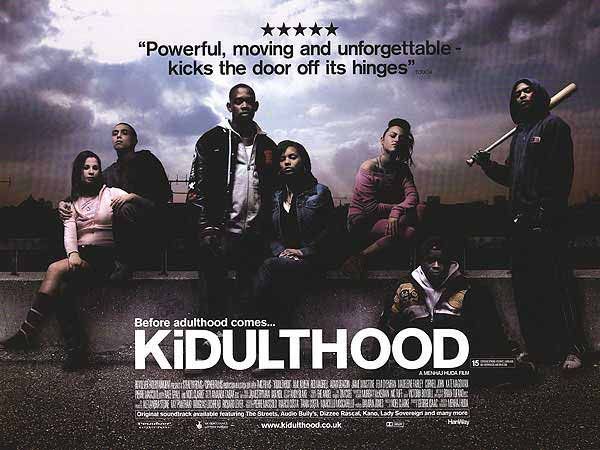 Kidulthood (2006) is a film focusing on a day in the life of a group of teenagers. The image is of the seven main characters, helping the audience to identify them should they see the film. Their arrangement shows some of the links between the characters too: Adam Deacon and Madeleine Fairley to the left are touching, implying they are in a relationship, as are Aml Ameen and Red Madrell in the centre (this central positioning also displaying that they are the main protagonists) then Jaime Winstone is next to Madrell, showing they are friends, while Femi Oyeniran sits off the wall, perhaps showing he is isolated from the group, and Noel Clarke is notably further away from the rest of the group and carrying a baseball bat, implying that he is the antagonist.
Even if one is perhaps not a friend of the others, they still appear to be a gang; they dress as stereotypical youths in baggy hoodies, trainers and short skirts and they give serious looks to the camera, looking quite menacing - especially Noel Clarke with his weapon. This appeals to the target audience as they are presumably like them, but also alienates adults who would perhaps look down on or feel threatened by them, which could possibly make it appeal even more to its target audience.
Unlike in Bullet Boy's poster, any mention of the actors or director's name is small as they weren't well-known when the film was made and the characters in the pictures are bathed in darkness, making them look more dangerous and proving they don't mind them not being all to visible as they don't have the pulling power of star names to attract a bigger audience. The darkness is matched in the colours of the characters' clothes: they are mostly dark and any bright colours appear to have been dulled. The background appears equally dull, showing the dark outline of a cityscape and a cloudy dull weather although, to ensure this connotation doesn't carry over to the film, they have light breaking through the clouds, making it appear more interesting but also connoting hope for the characters.
The tagline "Before adulthood comes..." explains what the title refers to in case there was any confusion and also helps to specify the target audience: if you are before adulthood, but not a child, you are a "kidult", and this film is for you. Although this arguably numbs the cleverness of the name somewhat, it might attract the audience better, which is more important. At the top there is a quote from a positive review, "Powerful, moving and unforgettable - kicks the door off its hinges...", and a 5-star rating, which attempts to prove the film is good and will make people want to see it. Also words like "powerful" and "moving" make it appear more artistic and will make people other than the "kidults" want to see it, as they may now consider it hard-hitting story on inner-city youth rather than just some rubbish film for teens. This quote is written over where the light is bursting through the clouds in contrasting black, making it stand out.
 Human Traffic (1999) is a comedy film focusing on a group of friends in the Cardiff club scene. The image is of 4 of the main characters in a variety of poses. The only female pictured, Lorraine Pilkingson, is the love interest of the main character and is pictured quite provocatively, peering over her shoulder and wearing high heels. She's tinted yellow which is an eye-catching colour that connotes happiness and intelligence, the latter perhaps trying to appease any women put off by her pose.
The other characters are all placed in a variety of slapstick poses: Danny Dyer in the middle of a dance move, John Simm while he appears to be bellowing and Shawn Parkes in a stance that could be interpreted in a number of different ways - he could be dancing, going to hug someone or something else. The calmest of the poses - Shaun Parkes' - is coloured red, a colour that connotes energy and passion could be an attempt to increase the excitement from his picture, while the perhaps sillier Danny Dyer and John Simm are coloured green and blue respectively, which connote stability and harmony, maybe in an attempt to calm them down, wary that some of the audience might find this off-putting. The way in which they are also tilted into different angles also makes it resemble Leonardo da Vinci's Vitruvian Man, suggesting that the makers wanted to show that the film wasn't just mindless dancing and shouting to those put off by the pictures of Dyer and Simm.
The diamond shape behind them is a reference to the title "Human Traffic" as it resembles a road sign, reinforcing the memory of the name to make the audience remember that that is the film they want to go and see.
The background is a beige camouflage pattern, this could have some army connotations but more likely it's playing to the fashion trends of the era, inviting young people to see it because it's cool and follows fashion, as camouflage patterns were more popular in the late nineties than they are now.
Much like Kidulthood's, the poster doesn't include any easily visible mentions of the names of the director or cast, because, at this time, they didn't have the star power necessary to attract an audience. Neither does it have any positive quotes from reviews; this could be because the film received bad reviews, meaning they deliberately wanted to avoid any critical responses, or they had made the poster before the film was finished or they had shown it to any critics. Instead, it has the tagline "You won't know what hit you" - this implies that the film isn't something you'd expect, another thing to persuade them in case they were put off by the rest of the poster, and is very good, particularly with the word "hit", which sounds quite aggressive, as if it's incredibly spectacular.

No comments:
Post a Comment